
Water Flosser vs String Floss: Which Is Actually Better?
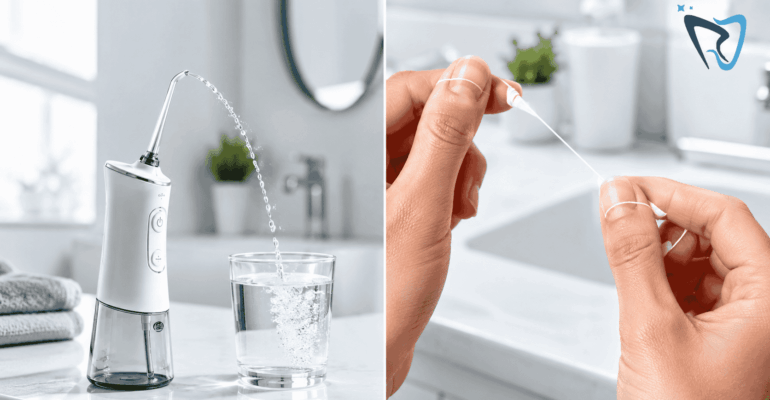
Water Flosser vs String Floss: Which Is Actually Better?
Water flosser vs string floss is one of the most debated questions in oral hygiene right now — and thanks to social media, it’s become a genuinely common topic of conversation. Water flossers have exploded in popularity over the past couple of years, with countless videos showing satisfying streams of water blasting debris from between teeth. But does that mean string floss is obsolete?
Not quite. Both tools work — but they work differently, and for some patients, one is a clear winner. For others, the best routine actually involves both.
At Ramlaoui DDS, we get asked about this constantly, especially from patients who’ve seen water flossers trending online and want to know if it’s worth making the switch. Here’s the honest, evidence-based breakdown — including what the research actually shows, who benefits most from each option, and how to build the routine that’s right for your mouth.
Table of Contents
- What Is a Water Flosser, Exactly?
- What Does String Floss Do Differently?
- Water Flosser vs String Floss: Full Comparison
- What Does the Research Actually Say?
- Who Should Use a Water Flosser?
- Who Should Stick With String Floss?
- The Best Routine: Can You Use Both?
- How to Use a Water Flosser Correctly
- Frequently Asked Questions
What Is a Water Flosser, Exactly?
A water flosser also called an oral irrigator is a small device that shoots a pressurized, pulsating stream of water between your teeth and along your gumline. You fill a reservoir with water, point the tip at the gumline, and the stream flushes out food particles, bacteria, and plaque from areas your toothbrush can’t reach.
Most water flossers come with adjustable pressure settings, multiple tip attachments for different needs (standard, orthodontic, periodontal pocket tips), and either a countertop reservoir model or a smaller cordless version for travel.
The appeal is obvious: it’s fast, it doesn’t require the dexterity or technique that string floss does, and for a lot of people it simply feels more pleasant. That’s a big deal — because the single biggest factor in oral hygiene isn’t which tool is theoretically superior. It’s which tool you’ll actually use every day.
💡 The Waterpik water flosser has been shown to remove up to 99.9% of plaque bacteria from treated areas in clinical testing — making it one of the most effective tools available for interdental cleaning.
What Does String Floss Do Differently?
String floss has been the gold standard for over a century for a simple reason: it makes direct physical contact with the tooth surface. When you slide floss between your teeth and curve it against each tooth, you’re mechanically scraping away the sticky biofilm of plaque that clings to enamel — something a stream of water, no matter how pressurized, can’t fully replicate.
Plaque isn’t just loose debris. It’s a living biofilm that adheres to your teeth, and breaking that adhesion really benefits from direct contact. This is where string floss has a genuine mechanical advantage.
The downside is well known: proper flossing technique takes some practice, it can be uncomfortable for people with sensitive or inflamed gums (especially when first starting a flossing habit), and it requires enough dexterity to maneuver floss around back molars — which can be genuinely difficult for people with arthritis, limited hand mobility, or braces.
Water Flosser vs String Floss: Full Comparison
Here’s the complete side-by-side breakdown:
| Factor | Water Flosser | String Floss |
| Plaque Removal | Very good — flushes debris & bacteria | Excellent — scrapes plaque off tooth surface |
| Gum Health | Gentle — reduces bleeding & irritation | Can irritate sensitive or inflamed gums |
| Ease of Use | Very easy — minimal technique needed | Requires proper technique and dexterity |
| Best For | Braces, implants, sensitive gums, bridges | Healthy gums, tight spaces between teeth |
| Cost | $30–$100 upfront + replacement tips | $2–$5 per roll — very low cost |
| Portability | Less portable, needs power/water source | Fits in any pocket or bag |
| Reaches Under Gumline | Yes — pulsating stream flushes pockets | Yes — direct mechanical contact |
| Effect on Bleeding Gums | Significantly reduces bleeding over time | Can initially increase bleeding if gums inflamed |
| Recommended Frequency | Once daily | Once daily |
| Counter Space / Setup | Requires water tank, charging, storage | None — zero setup |
The short version: string floss has the edge on mechanical plaque removal from tooth surfaces. Water flossers have the edge on gum health, ease of use, and accessibility for people with dexterity challenges, braces, or dental work.
What Does the Research Actually Say About Water Flosser vs String Floss?
This is where things get interesting and where a lot of marketing claims get ahead of the science. Here’s an honest look at what studies have actually found:
Plaque Removal
Some studies funded by water flosser manufacturers have found water flossers to be significantly more effective at plaque removal than string floss with figures like 29% better performance frequently cited. Independent research has been more mixed, with some studies finding water flossing performs comparably to string flossing rather than dramatically outperforming it. The honest conclusion: both methods meaningfully reduce plaque when used consistently, and the manufacturer-funded studies showing large advantages for water flossers should be read with appropriate skepticism.
Gum Bleeding and Inflammation
This is where water flossers have the strongest evidence. Multiple studies including research on patients with dental implants have found that water flossing is associated with significantly less gum bleeding compared to string flossing. One study comparing implant patients found that 18 of 20 implants in the water flosser group showed reduced bleeding after 30 days, compared to only 6 of 20 in the string floss group.
🔗 Journal of Pharmacy and Bioallied Sciences — Water Flosser vs String Floss Study →
The Real Determining Factor: Consistency
Across nearly every study and every dental professional’s experience, one theme repeats: the best flossing method is the one you’ll actually use every single day. A water flosser that gets used nightly will do more for your gum health than string floss that sits unused in a drawer. This sounds obvious, but it’s the single most important takeaway from the research.
🔗 National Institutes of Health — Interdental Cleaning Aids Review →
💡 If switching to a water flosser means you go from flossing twice a week to flossing every night, that’s a major win for your oral health — regardless of which tool theoretically performs better in a lab.
Who Should Use a Water Flosser?
Water flossers are an excellent sometimes ideal choice for patients in these situations:
- Braces or orthodontic appliances water flossers reach around brackets and wires that string floss struggles to navigate without snagging
- Dental implants and bridges string floss can be difficult to maneuver around these structures, and water flossers clean effectively without risking damage
- Sensitive or bleeding gums the gentler pulsating stream is far less likely to cause irritation, especially for patients just starting a consistent oral hygiene routine
- Limited dexterity — arthritis, hand injuries, or other mobility issues that make maneuvering string floss difficult
- Periodontal pockets patients being treated for gum disease often benefit from the deeper-reaching pulsating action, especially with a specialized periodontal tip
- Anyone who simply won’t floss otherwise if string floss has never stuck as a habit, a water flosser might be the tool that finally makes daily interdental cleaning happen
👉 Read More: Gum Disease — 8 Warning Signs You Should Never Ignore
Who Should Stick With String Floss?
String floss remains an excellent — and often the better — choice for:
- Patients with healthy gums and good manual dexterity who already have a consistent flossing habit
- Tight contact points between teeth where direct mechanical scraping is especially valuable
- Anyone on a tight budget — string floss costs a few dollars and lasts months, with zero ongoing cost
- Travelers — floss fits in a pocket; water flossers require counter space, water access, and (for most models) a power source
- Patients who want the most thorough mechanical plaque removal and don’t mind the technique required
If your gums are healthy, you floss consistently, and you’re not dealing with braces, implants, or sensitivity — there’s no urgent reason to switch. String floss is doing its job.
The Best Routine: Can You Use Both?
Yes — and for many patients, this is genuinely the best answer. Using both tools together gives you the mechanical plaque-scraping benefit of string floss and the gentle gumline-flushing benefit of a water flosser.
A simple combined routine looks like this:
- Brush twice daily with a soft-bristled toothbrush
- Floss with string floss once daily to mechanically remove plaque between teeth
- Follow with a water flosser to flush remaining debris and bacteria from along the gumline and any hard-to-reach areas
- Finish with a fluoride mouthwash if recommended by your dentist
This combination takes maybe 60–90 extra seconds compared to using just one tool — a small investment for patients who want to be especially thorough, particularly those managing gum disease, braces, or implants.
✅ Healthy gums, good habits: String floss alone is sufficient. A water flosser is a nice addition but not essential.
✅ Braces, implants, bridges, or sensitive gums: A water flosser should be a core part of your routine — ideally alongside string floss where you can manage it.
✅ Struggling to floss consistently at all: Start with a water flosser. Any consistent interdental cleaning is better than none, and it may be the habit that finally sticks.
How to Use a Water Flosser Correctly
If you decide to add a water flosser to your routine, technique still matters. Here’s how to get the most out of it:
- Fill the reservoir with lukewarm water — cold water can be uncomfortable on sensitive teeth
- Start on the lowest pressure setting, especially if you’re new to water flossing or have sensitive gums, and increase gradually
- Lean over the sink — this isn’t a neat process at first
- Aim the tip at a 90-degree angle to your gumline, pausing briefly between each tooth before moving to the next
- Work systematically around your entire mouth — start at the back on one side and work all the way around
- Use for about 60 seconds total, covering all surfaces — front, back, and between every tooth
- Clean the device’s reservoir and tips regularly to prevent bacterial buildup in the unit itself
Most people notice a difference in gum bleeding within the first 1–2 weeks of consistent use. If bleeding doesn’t improve — or worsens — after a few weeks of consistent use, that’s worth mentioning at your next dental visit.
Questions About Your Oral Hygiene Routine? Let’s Talk at Your Next Visit
Whether you’re team water flosser, team string floss, or team “both, every night without exception” — the most important thing is that you have a consistent routine that works for your mouth and your lifestyle.
At Ramlaoui DDS, we look at your gum health, your specific dental work (implants, braces, bridges), and your habits at every checkup, and we’ll tell you honestly which interdental cleaning approach makes the most sense for you. If your gums bleed, if you have new dental work, or if floss has just never worked for you — bring it up. There’s almost always a better option than just giving up.
We serve patients throughout San Jose and the Bay Area, and we’re always happy to talk through your home care routine at your next cleaning.
Related reading from our blog:
👉 Gum Disease: 8 Warning Signs You Should Never Ignore
👉 Sensitive Teeth: 11 Causes, Proven Treatments & When to See a Dentist
Water Flosser vs String Floss FAQs
Can a water flosser fully replace string floss?
For most patients, a water flosser can serve as your primary interdental cleaning tool — especially if it means you actually use it daily. However, dentists generally still recommend string floss for its superior mechanical plaque-scraping action where possible. If you can only commit to one, the better choice is whichever one you’ll use consistently. If you can do both, that’s ideal.
Is a water flosser good for gum disease?
Water flossers can be a helpful part of managing gum disease, particularly because the pulsating action helps flush bacteria from periodontal pockets and has been shown to reduce gum bleeding. However, a water flosser is not a substitute for professional periodontal treatment if you already have gum disease. Think of it as an excellent maintenance tool alongside — not instead of — professional care.
How often should I use a water flosser?
Once daily is the standard recommendation, similar to traditional flossing. Most people find evening use — after their last meal of the day and before brushing — works well as part of a nightly routine.
Do water flossers hurt if you have sensitive gums?
Generally, no — and this is actually one of their biggest advantages. Start on the lowest pressure setting and use lukewarm water. Most patients with sensitive gums find water flossers significantly more comfortable than string floss, especially when their gums are inflamed. If you experience pain even on the lowest setting, mention it to your dentist.
Are expensive water flossers worth it over budget options?
The core function — a pressurized pulsating water stream — is similar across most reputable brands. More expensive models typically offer more pressure settings, larger reservoirs, additional tip attachments (orthodontic, periodontal, plaque seeker), and quieter motors. For most patients, a mid-range model with adjustable pressure and a couple of tip options covers everything you need. The most important factor remains consistent use, not the price tag.
Can I use a water flosser with braces?
Yes — and many orthodontists specifically recommend it. Water flossers are excellent at clearing food particles and plaque from around brackets and wires, areas where string floss can be difficult and frustrating to navigate. Many water flosser brands offer an orthodontic tip specifically designed for this purpose.
Will switching to a water flosser save me money long-term?
The upfront cost of a water flosser ($30–$100+) is higher than a few rolls of string floss ($2–$5 each). However, if a water flosser means you avoid gum disease treatment, periodontal maintenance, or other costs associated with poor gum health, the long-term value can be significant. That said, string floss used consistently is also extremely cost-effective — the financial comparison ultimately comes down to which tool helps you maintain better gum health over years, not the sticker price.
Final Thoughts
Water flosser vs string floss doesn’t have to be a competition with one winner. Both tools genuinely work, both have research supporting their benefits, and the right choice depends heavily on your gum health, your dental work, and — most importantly — what you’ll actually stick with every day.
If you’ve been curious about water flossers because of what you’ve seen online, there’s good reason for the hype — particularly for gum health and ease of use. But don’t feel like you need to throw out the string floss either. The best routine is the one that gets done, consistently, night after night.
The team at Ramlaoui DDS is happy to talk through your specific situation at your next visit and help you build a routine that actually fits your life. We serve patients throughout San Jose and the Bay Area.

