
Sensitive Teeth: 11 Causes, Proven Treatments & When to See a Dentist
Sensitive Teeth: 11 Causes, Proven Treatments & When to See a Dentist
Sensitive teeth are more common than most people realize and more treatable than most people expect. If you’ve ever winced biting into ice cream, tensed up sipping hot coffee, or felt a sudden zing of pain when cold air hit your teeth, you’ve experienced it firsthand.
The discomfort can range from a mild annoyance to a sharp, shooting pain that stops you mid-bite. Either way, it’s your mouth telling you something is worth paying attention to.
The good news: in the vast majority of cases, tooth sensitivity has a clear cause — and a clear fix. This guide walks you through everything, from why teeth become sensitive in the first place, to which treatments actually work, to when it’s time to stop managing it at home and come see us at Ramlaoui DDS in San Jose.
Table of Contents
- What Is Tooth Sensitivity — And Why Does It Happen?
- 11 Most Common Causes of Sensitive Teeth
- Causes & Treatments at a Glance
- How to Treat Sensitive Teeth at Home
- Professional Treatments for Sensitive Teeth
- Foods and Drinks That Make Sensitivity Worse
- When Sensitive Teeth Signal Something More Serious
- How to Prevent Sensitive Teeth
- Frequently Asked Questions
What Is Tooth Sensitivity — And Why Does It Happen?
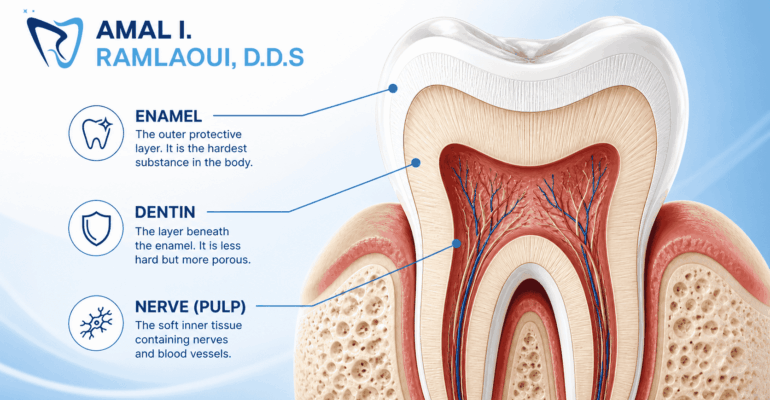
To understand sensitive teeth, it helps to understand what a tooth is made of. The outer layer — enamel — is the hardest substance in the human body. It acts as a protective shield over the softer inner layer called dentin. Dentin contains thousands of microscopic channels called tubules that lead directly to the nerve at the center of the tooth.
When enamel wears down or gums pull back and expose the root (which has no enamel protection at all), those tubules become exposed. Heat, cold, sweetness, or even a blast of cold air can then travel straight to the nerve — triggering that sharp, familiar pain.
💡 Tooth sensitivity isn’t a disease. It’s a symptom — and finding the underlying cause is the key to treating it properly.
According to the Cleveland Clinic, tooth sensitivity is one of the most common dental complaints among adults, affecting a large portion of the population at some point in their lives.
11 Most Common Causes of Sensitive Teeth
1. Enamel Erosion
Enamel doesn’t grow back once it’s gone. Acidic foods and drinks — citrus, soda, coffee, wine — gradually wear it away over time, exposing the dentin beneath. This is one of the most common causes of widespread sensitivity affecting multiple teeth at once.
2. Gum Recession
When gum tissue pulls away from the tooth — whether due to gum disease, aggressive brushing, or genetics — it exposes the root surface. Unlike the crown of the tooth, roots have no enamel covering, making them extremely vulnerable to sensitivity triggers.
3. Brushing Too Hard
More pressure doesn’t mean cleaner teeth. In fact, brushing too vigorously with a medium or hard-bristled toothbrush is a leading cause of both enamel abrasion and gum recession — two things that directly cause sensitive teeth. Use a soft-bristled toothbrush and light, circular strokes.
4. Teeth Grinding (Bruxism)
Many people grind their teeth at night without knowing it. Over months and years, bruxism grinds down enamel — sometimes dramatically — leaving teeth thinner, weaker, and far more sensitive. If you wake up with jaw soreness, headaches, or notice your teeth look flatter at the edges, grinding may be the culprit.
5. A Cracked or Chipped Tooth
A crack in a tooth — even a hairline fracture that’s invisible to the naked eye — can cause sensitivity in a very specific spot. The sensitivity tends to be sharp, localized, and triggered by biting pressure rather than temperature. If you notice sensitivity in just one tooth, a crack or chip is worth investigating.
6. Tooth Decay or a Cavity
As a cavity progresses, it moves closer to the nerve. Early cavities may cause sensitivity to sweets; deeper cavities cause sensitivity to temperature. If one tooth is suddenly more sensitive than the rest, decay is high on the list of possibilities.
7. A Worn or Leaking Filling
Old fillings can crack, shrink, or pull away from the tooth over time. When that happens, bacteria get into the gap and the exposed dentin underneath becomes sensitive. This is why regular checkups matter — we catch these issues before they become painful.
8. Recent Dental Work
It’s completely normal to experience some sensitivity after a filling, crown, teeth cleaning, or whitening treatment. The tooth has been worked on and needs time to settle. In most cases, this kind of sensitivity resolves on its own within 2 to 4 weeks. If it doesn’t, give us a call.
9. Teeth Whitening Products
Over-the-counter whitening strips and gels are a common trigger for temporary sensitivity. The bleaching agents penetrate the enamel and can irritate the nerve — especially with repeated use. Professional whitening at Ramlaoui DDS uses controlled concentrations and application techniques that significantly reduce this risk.
👉 Read More: Professional Teeth Whitening — 7 Reasons It Beats At-Home Kits
10. Acidic Foods and Drinks
You don’t need an underlying dental problem for sensitivity to develop. A diet consistently high in acidic foods — citrus fruits, tomatoes, vinegar-based foods, fizzy drinks, sports drinks — can erode enamel over time all on its own. The damage is cumulative and often goes unnoticed until sensitivity becomes noticeable.
11. Gum Disease (Periodontitis)
Gum disease causes the supporting tissue and bone around teeth to break down. As gums recede and bone is lost, root surfaces are exposed. Sensitivity from gum disease tends to develop gradually and is often accompanied by other signs like bleeding when brushing, persistent bad breath, or gum tenderness.
Causes & Treatments at a Glance
Here’s a quick-reference breakdown of the most common causes of sensitive teeth and what each one typically requires:
| Cause | What’s Happening | Fix |
| Enamel erosion | Acid wears down protective outer layer | Fluoride treatment, dietary changes |
| Gum recession | Roots exposed — no enamel protection there | Scaling, gum graft if severe |
| Brushing too hard | Abrasion damages enamel and gumline | Soft brush, gentle circular motion |
| Teeth grinding (bruxism) | Enamel worn down overnight without you knowing | Custom night guard |
| Cracked tooth | Crack exposes inner dentin or nerve | Crown, bonding, or root canal |
| Tooth decay / cavity | Cavity exposes dentin as it progresses | Filling or crown |
| Recent dental work | Temporary post-procedure sensitivity | Usually resolves in 2–4 weeks |
| Whitening products | Bleaching agents temporarily sensitize dentin | Professional whitening with lower risk |
| Acidic foods & drinks | Repeated acid exposure erodes enamel | Limit intake, rinse with water after |
| Gum disease | Infected gums recede and expose roots | Deep cleaning, periodontal treatment |
How to Treat Sensitive Teeth at Home
Mild to moderate sensitivity that isn’t linked to a crack, cavity, or gum disease can often be managed effectively at home. Here’s what actually works:
Switch to a Desensitizing Toothpaste
This is the first thing to try. Desensitizing toothpastes contain compounds like potassium nitrate or stannous fluoride that either block the dentinal tubules or calm the nerve over time. They don’t work overnight — consistent use for 2 to 4 weeks is usually needed before you notice a difference. Use it as your regular toothpaste, not just an occasional treatment.
Use a Soft-Bristled Toothbrush
If you’re still using a medium or firm toothbrush, switch today. A soft-bristled brush cleans your teeth just as effectively without the enamel abrasion. Pair it with a gentle, circular brushing technique rather than the back-and-forth scrubbing motion most people use.
Avoid Highly Acidic Foods and Drinks
You don’t have to give up coffee or citrus entirely, but reducing frequency and rinsing your mouth with plain water immediately after helps limit enamel exposure to acid. Drinking acidic beverages through a straw also reduces contact with teeth.
Don’t Brush Immediately After Eating
This surprises many people. After eating acidic foods or drinking acidic beverages, the enamel is temporarily softened. Brushing immediately can scratch and wear away the softened enamel. Wait at least 30 minutes before brushing.
Use a Fluoride Mouthwash
A fluoride rinse used once daily can help strengthen enamel and reduce sensitivity over time. Look for alcohol-free formulas, as alcohol-based rinses can actually irritate already-sensitive teeth.
💡 Home remedies can manage mild sensitivity — but they can’t fix a cavity, a crack, gum disease, or worn-down enamel. If sensitivity persists beyond 4 weeks, it’s time to see a dentist.
Professional Treatments for Sensitive Teeth
When home care isn’t enough — or when the underlying cause requires professional attention — these are the treatments we use at Ramlaoui DDS:
In-Office Fluoride Treatment
A concentrated fluoride gel or varnish applied directly to sensitive areas strengthens enamel and blocks exposed tubules. It’s quick, painless, and often provides noticeable relief after a single application. This is typically the first professional treatment we recommend for generalized sensitivity.
Dental Bonding
If sensitivity is caused by exposed root surfaces or enamel erosion in specific areas, dental bonding can be applied to cover and protect those spots. A tooth-colored composite resin is bonded directly to the affected area, sealing the exposed dentin and eliminating the sensitivity trigger. Results are immediate.
Custom Night Guard
For patients whose sensitivity is caused by teeth grinding, a custom-fitted night guard is one of the most effective solutions available. It creates a protective barrier between the upper and lower teeth, preventing the grinding that wears down enamel. Unlike store-bought guards, a custom night guard from Ramlaoui DDS is made from an exact impression of your teeth — so it fits properly and actually stays in while you sleep.
Scaling and Root Planing (Deep Cleaning)
When gum disease is the cause of sensitivity, a deep cleaning procedure called scaling and root planing removes bacteria and tartar from below the gumline and smooths the root surfaces. This allows gum tissue to reattach and heal — reducing sensitivity and stopping further recession.
Gum Graft Surgery
For a significant gum recession that has left root surfaces exposed, a gum graft uses tissue (either from your palate or a donor source) to cover and protect the exposed root. It’s a more involved procedure but often the most effective long-term solution for recession-related sensitivity.
Root Canal
When sensitivity is severe, persistent, and linked to infection or significant nerve damage, a root canal removes the affected nerve tissue from inside the tooth — eliminating sensitivity at its source. Root canals have a very outdated reputation for being painful. Modern techniques make them feel much like getting a routine filling.
Foods and Drinks That Make Sensitive Teeth Worse
If you’re dealing with sensitivity, these are the most common dietary triggers — and a few surprising ones worth knowing about:
- Ice and ice-cold drinks — cold is the most common sensitivity trigger
- Hot coffee, tea, and soup — temperature extremes on both ends
- Citrus fruits (lemons, limes, grapefruit, oranges) — high acid content erodes enamel
- Carbonated drinks including sparkling water — carbonic acid is still acid
- Sports and energy drinks — highly acidic and often overlooked
- Wine (both red and white) — white wine in particular is surprisingly acidic
- Tomatoes, tomato sauce, and ketchup — higher acid than most people realize
- Sweets and candy — sugar feeds the bacteria that produce enamel-eroding acids
- Pickles and vinegar-based foods — acetic acid is a significant enamel eroder
You don’t need to eliminate all of these. The key is moderation, rinsing with water after consuming them, and addressing any underlying enamel or gum issues that are making your teeth more vulnerable in the first place.
When Sensitive Teeth Signal Something More Serious
Most sensitivity is manageable with the right care. But there are situations where sensitivity is a warning sign that something more urgent is going on. At Ramlaoui DDS, we recommend scheduling an appointment promptly if you experience any of the following:
⚠️ See a dentist soon if sensitivity is sharp and localized to one tooth — this can indicate a crack, deep cavity, or abscess.
- Sensitivity that lingers for more than 30 seconds after the trigger is removed — this can indicate nerve involvement
- Spontaneous pain that comes without any trigger (no hot, cold, or pressure)
- Pain when biting or chewing, particularly in one specific spot
- Visible swelling, redness, or a bump on the gum near a sensitive tooth
- Sensitivity accompanied by a bad taste or odor, which can signal infection
- Sensitivity that has been getting progressively worse over weeks or months
- Pain that wakes you up at night
These symptoms don’t necessarily mean the worst-case scenario — but they do mean a proper evaluation is overdue. Many serious dental issues start as sensitivity that patients ignore for too long. Catching them early almost always means simpler, less expensive treatment.
How to Prevent Sensitive Teeth
Once you’ve treated the underlying cause, keeping sensitivity from coming back comes down to a consistent daily routine:
- Use a soft-bristled toothbrush and replace it every 3 months
- Brush gently — two minutes, twice a day, with a circular rather than scrubbing motion
- Floss every night to protect gum tissue and prevent gum disease
- Use a fluoride toothpaste — preferably one formulated for sensitivity
- Wear a custom night guard if you grind or clench your teeth
- Limit acidic food and drink intake and rinse with water after consuming them
- Schedule professional cleanings every six months — early detection saves teeth
- Don’t ignore minor sensitivity — it’s easier and less expensive to treat early
The American Dental Association recommends twice-yearly dental visits as the foundation of long-term oral health. This is especially true for patients with a history of sensitivity, gum recession, or enamel erosion — regular monitoring allows us to catch changes before they become problems.
Dealing With Sensitive Teeth in San Jose? Let’s Find the Cause.
Tooth sensitivity is one of the most common reasons patients come to see us — and one of the most satisfying problems to solve, because relief is almost always achievable once we identify what’s actually causing it.
At Ramlaoui DDS, we take a thorough, unhurried approach to diagnosing sensitivity. We look at the full picture — your enamel health, gum levels, bite, grinding habits, and diet — so we can recommend the right treatment, not just a temporary patch.
Whether your sensitivity is mild and intermittent or sharp and ongoing, we’d love to help you get comfortable again.
Explore related topics from our blog:
👉 Smile Makeover: 6 Treatments That Transform Your Smile
👉 Professional Teeth Whitening: 7 Reasons It Beats At-Home Kits
FAQs — Sensitive Teeth in San Jose
Why are my teeth suddenly sensitive?
Sudden sensitivity — especially in one tooth — is usually a sign of something specific: a crack, a new cavity, a failing filling, or the start of gum recession. If it came on quickly and is localized to one spot, don’t wait. A dental exam can identify the cause before it progresses.
Can sensitive teeth be cured permanently?
It depends on the cause. If sensitivity is due to a cavity, crack, or worn filling, treating the underlying issue often eliminates it completely. If it’s due to enamel erosion or gum recession that can’t be reversed, the goal is to manage and prevent it from worsening. Many patients find their sensitivity dramatically reduces or disappears entirely with the right combination of home care and professional treatment.
How long does tooth sensitivity last?
Post-procedure sensitivity (after a filling, cleaning, or whitening) typically resolves in 2 to 4 weeks. Sensitivity from an ongoing cause — like grinding, gum recession, or enamel erosion — will persist until that cause is addressed. Home treatments like desensitizing toothpaste can take 2 to 6 weeks of consistent use before you notice a meaningful difference.
Is tooth sensitivity a sign of cavities?
It can be, but it’s not always. Sensitivity to sweets in particular can be an early sign of a cavity — sweets trigger a response in cavities that temperature changes sometimes don’t. However, sensitivity to hot and cold can also come from enamel erosion, gum recession, grinding, and many other causes that have nothing to do with decay. A dental exam is the only reliable way to know which is which.
Can I whiten my teeth if they’re sensitive?
Yes, but carefully. Over-the-counter whitening products are a common sensitivity trigger and can make existing sensitivity worse. Professional whitening at Ramlaoui DDS uses controlled techniques that minimize sensitivity risk — and we’ll evaluate your enamel health before recommending whitening to make sure it’s appropriate for your situation.
Does sensitivity mean I need a root canal?
Not usually. Most sensitivity has causes that don’t involve the nerve and can be treated with much simpler approaches. A root canal becomes necessary when the nerve inside the tooth is infected or severely damaged — typically indicated by persistent spontaneous pain, prolonged sensitivity after the trigger is removed, or visible abscess. If we see any of these signs, we’ll tell you clearly and explain all your options.
What’s the best toothpaste for sensitive teeth?
Toothpastes containing potassium nitrate or stannous fluoride are the most effective for managing sensitivity. Popular options include Sensodyne, Colgate Sensitive, and Pronamel. Consistency matters more than the brand — use it as your everyday toothpaste for at least 4 weeks before evaluating results. If you have questions, ask us at your next appointment and we’ll recommend the right option for your specific situation.
Final Thoughts
Sensitive teeth are a signal, not a sentence. They’re telling you that something in your mouth needs attention and the sooner you listen, the easier the fix usually is.
Whether the cause is as simple as brushing too hard or as involved as gum recession or a cracked tooth, there’s a treatment path that can get you back to eating and drinking without wincing. You shouldn’t have to plan your meals around tooth pain.
The team at Ramlaoui DDS is here to help you find the cause, fix the problem, and keep it from coming back. We serve patients throughout San Jose and the Bay Area with care that’s thorough, honest, and focused on what’s right for you.

